Seventy-Five Years in Beautiful Burma
Dreaming of the 75th Anniversary
As the news was spreading about the 75th anniversary celebration of the presence of La Salette in Burma in November of 2012, I was already dreaming and praying to be part of this historical event.
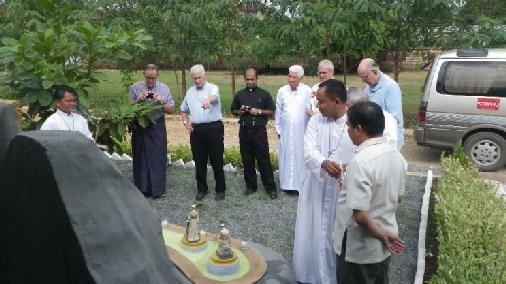
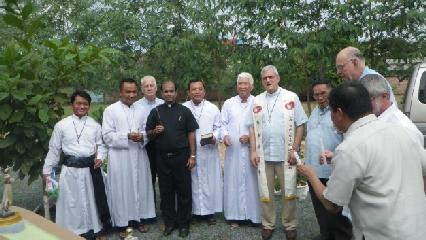
Very Rev. Fr. Silvanno Marissa, the General Superior and two of his councilors, Fr. Joe Bachand and Fr. Efren Musnji represented the Generalate of the Missionaries of La Salette from Rome to take part in this solemn celebration. Frs. Jack Nuelle, Pete Kholer, Bill Slight and myself travelled to Myanmar from the U.S. Frs. Rosanno Sorriano and Sal Pico came from the Philippines. Then there was a group of about 20 Filippino friends of Fr. Bernie Taylor, the first Burmese La Salette that came to witness this event. All of us gathered in a restaurant in Yangon for lunch on the 5th of November and then after a short siesta we spent the afternoon on a bus tour of Yangon.
With Fr. Sal Pico officiating we celebrated Mass at St. Theresa Church, a Chinese mission in Ahlone, Yangon. Yangon is an incredibly safe city. You are not likely to be robbed here. No late nights here-just about the entire city closes down by 9pm. Myanmar’s biggest city, Yangon, is comparatively young. Our visit to Shwedagon Pagoda by night was spectacular and breath-taking. Is there a more stunning monument to religion in Southeast Asia? I asked. The sheer size 326 feet high and the mystical aura of this gilded masterpiece stands out among thousands of pagodas throughout the country. What a great introduction to the famous pagodas!
PAGODA HEIGHT
326 ft
Shwedagon gilded spire stands high in Yangon.
CITY SAFETY
High
Incredibly safe city; robbery is highly unlikely.
NIGHT CURFEW
9:00 PM
Just about the entire city closes down at dusk.
MISSION PRESENCE
75 Years
Gathering in Nov 2012 for the diamond presence.
For more than a century, Myanmar remained a world apart, isolated from other nations due to foreign and military rule. The UN recognizes the name Myanmar as the nation’s official name. What to call the Republic of the Union of Myanmar has been a political flashpoint since 1989, when the military ‘hunta’ decided to consign Burma, the name commonly used since the mid-19th century.
Myanmar is a sovereign state in Southeast Asia, bordered by India, Bangladesh, China, Laos and Thailand. The official language is Myanmar, which is spoken by virtually all of Myanmar people. There are also many dialects spoken. English is considered their second language, which is spoken only by the educated population.
Multicultural Myanmar is more a salad bowl than a melting pot. The government recognizes 135 distinct ethnic groups that make up eight official major national ethnic races: Bamar, Shan, Mon, Kayin, Kayah, Chin, Kachin and Rakhaing.
To travel here is to encounter men wearing skirt-like longyi, women smothered in thanakha(traditional make-up) and betel-chewing grannies with mouths full of blood-red juice. If you don’t like to compromise on such things as food and hotel quality and if you have a low tolerance for last minute changes of plan or being denied conveniences such as guaranteed round-the–clock power, use of ATMS and credit cards, then you may not want to travel in Myanmar.
The Pillars of Buddhist Dhamma
Buddhism is practiced by almost 90% of Burma’s population. Because the people are deeply pious, there is at least one pagoda or Buddha image in every town, city and even villages. There are also monasteries or schools to train Buddhist monks.
There is a Buddhist ‘lent’ on the Myanmar calendar which lasts for three months in the rainy season, approximately July to October. During this time fasting is practiced, marriages and moving to a different residence is postponed. Myanmar people are known for their desire for fun. As Myanmar culture is closely intertwined with Buddhism, most of Myanmar festivals center around some religious events.
At the Festival of Lights, the Buddhist people from all over the country illuminate decorated lights in the evenings in reverence to the Buddha. The Water Festival marks the coming of a new year on the lunar calendar. Almost everyone in the country regardless of age, gender or nationality and belief, participate by throwing water on each other using bowls, buckets or pipes.
The Four Noble Truths & Eight Paths
1
Life is Suffering
Existence carries a baseline of dissatisfaction and hardship.
2
Origin of Suffering
All struggle and pain arises from selfish desires and attachment.
3
Cessation of Desire
When one forsakes selfish desires, suffering will be extinguished.
4
The Eight Paths
Extinguished via Right Thought, Speech, Action, and Livelihood.
8 Paths to achieve those truths.
Mandalay & Anniversary Chronicles
Chronicles of the 75th Jubilee presence in Chanthagone and Fr. Bernie Taylor's 40th priesthood ordination anniversary.
Mandalay: The Cultural Capital
There are other religions in Myanmar, but they are not as widespread as Buddhism. only 4% of the people are Christians and 4% Muslims and the rest are Hindus and other minor religions. Christianity was brought to Myanmar by European missionaries in the 19th century.
We arrived in Mandalay by plane after spending an overnight stay in Yangon. As Burma’s last royal capital, Mandalay has retained many fine monastic buildings. Mandalay is considered Myanmar’s cultural capital. There are numerous antique shops. What a wonderful welcome they gave us! As we got off the bus into the shrine ground, each one was welcomed with a garland of fresh flowers placed around our necks. Then we celebrated Mass at the Shrine Chapel followed by lunch.
In Mandalay we travelled by bus to various attractions. The following day we passed by Don Bosco Spiritual Renewal Center in Anisakan situated almost on the top of a hill. The Don Boscan priests invited us to celebrate mass in their beautiful chapel after which they served us snacks. The hospitality of the Don Boscans I must say was as close to the hospitality of the La Salettes. (just kidding) They were great! I was attracted to the theme of the Spiritual Center, “Restore: Rebuild; Restart LIFE”.
Then we stopped at a water fall (Pwe Gauk Fall). Close to the water fall was a hanging bridge. Every one took the opportunity to walk on it. Then it was the favorite time especially for the ladies in the group-shopping time! I believe the only thing I missed was visiting the National Gardens. What I needed was a good siesta in the bus.
Burma accounts for nearly one third of the world’s total teak production. The U Bien Bridge, which is 1.2 km long is the longest teak wood bridge in the world. We visited this famous bridge. It is situated across the Taungthaman Lake 6 miles south of Mandalay, Burma. The recent tourist boom has added more significance to the U Bien bridge. The tourists have become a major source of income to the local businesses. We also spent some time looking at the National Royal Palace in Mandalay. Today, Mandalay palace is a primary symbol of Mandalay, a historical monument and a major tourist destination.
The 40-Year Journey of Fr. Bernie Taylor
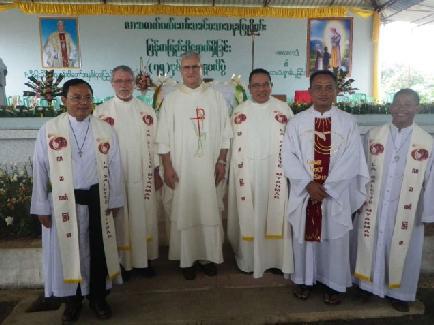
On November 8th, we gathered with more than 50 priests from the area-dioceses and hundreds of people in an open pavilion adjacent to the Marian Shrine of the Our Lady of the Rosary in Chanthagone, where the Burmese La Salettes started to minister in 2005. We celebrated the 40th anniversary of the Priesthood of Fr. Bernie Taylor.
In his homily Fr. Bernie said that the essence of priesthood is to be of service to others. He continued, “On the day of my ordination I recognized that my priesthood was not for myself but for others and that it was to be a life of service to the people of God. He gave thanks for the people in his life those who shaped him-his friends, most especially his family and the La Salette Community. He recalled the difficulties and struggles he had to go through in order to become a La Salette missionary.
He said, “I joined the La Salette Minor Seminary in Akyab(now Sittwe) in 1962 and was sent to the Philippines the next year. However, since still I was living in Burma, I was not able to get to any La Salette Novitiate so I finished my theological studies and was ordained for the Diocese of Prome(now Pyay). The La Salette missionaries in Burma had to leave the country. So I worked in the diocese of Prome. Finally after 20 years I was able to finish my novitiate program and took my vows in 1982. God had a plan for my life.”
He is proud of the fact that the Burmese La Salette mission has grown without limits and bounds. Now there are 12 Burmese La Salette priests and a few others in formation. Fr. Bernie looks back with pride and gratitude for everything that happened to re-establish a La Salette presence in Myanmar. He thanked everyone who supported him during his priestly journey for the past 40 years and asked them to continue their prayers for him and the continued growth of the La Salette mission in Myanmar. After the solemn celebration of Mass and a sumptuous meal for everyone who attended there was an evening of dance and music followed by presentation of gifts for the celebrant Fr. Bernie. It was a very enjoyable evening with lots of entertainments.
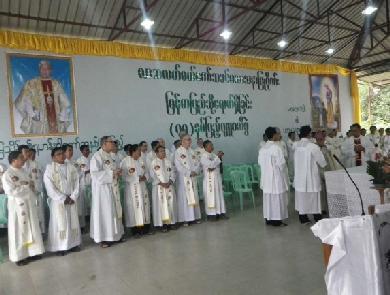
Celebrating Seventy-Five Years in Myanmar
The next day, an even larger crowd gathered under the same pavilion at the shrine compound in Mandalay to celebrate the 75th anniversary of the La Salette mission in Myanmar.
In his message, Bishop Alexander, the Bishop of Pyay said, “we come together to thank the Lord for this great occasion. The first La Salette missionaries went through hardships and pains and even death but they have proclaimed the Word of God with courage and handed down the legacy of faith in this land of Myanmar particularly in the diocese of Pyay. We continue to thank the Lord for His guidance, for bringing back the La Salette missionaries to Myanmar through Fr. Bernie Taylor as the pioneer. Is it not the power of the Holy Spirit that prepared him to recruit some fine Myanmar young men to become missionaries?”
He said proudly, “there are 12 native La Salette missionaries in our midst here in this little village in Chanthagone, where they have their base. “We are all God’s missionaries today. At baptism, we are given a lighted candle and the priest said, “Receive the light of Christ. We are all sent out to proclaim the good news to all people that Jesus Christ is the light of the world.”
The Bishop quoted Pope Benedict XVI, who at his regular public audience on October 17, 2012 said, “Christians today often do not even know the central core of their Catholic faith or the basics of their faith. Ignorance about the fundamentals of faith leaves believers vulnerable to certain forms of syncretism and religious relativism, with no clarity about which truths must be believed and the salvific uniqueness of Christianity”.
“In this year of new evangelization and the Year of Faith, the bishop concluded, let us be open to renew our own faith. Let us be ready to follow our Mother at La Salette and be obedient to follow the command of our Lord. Through the intercession of Blessed Mother, may God bless you with his peace and joy.”
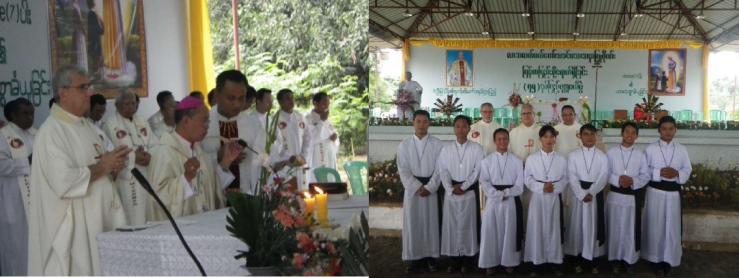
The Temporary Religious Vows of Seven Novices
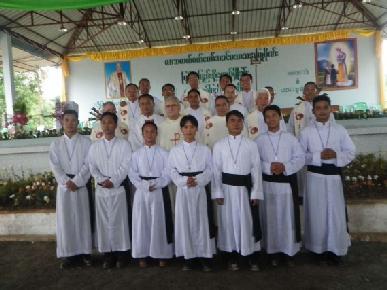
At the conclusion of their Novitiate year, seven Burmese brothers took temporary religious vows during this occasion before their beloved parents, brothers and sisters, and their friends. The rite of profession began right after the Bishop’s homily.
Seven fine young men gifted and blessed choose to live in chastity, poverty and under obedience in this world of ours. When they made their vows, at the very moment when they offered themselves, body, heart and soul to the Lord, they were transformed into such beautiful beings. They chose to surrender everything they possess to embrace a humble life style of “poverty, chastity and obedience” with total submission to their God in response to His call of sacrificial love.
Through this act of consecration, they were embraced by God in return. Their hearts echoed with joy and peace. That radiance of beauty I witnessed on their faces was indescribable, so much so that I was gazing at them in awe! I could only praise God and thank Him for calling them, setting them apart for His divine plan. As we pray for more vocations, let us also pray for ourselves, that we courageously respond to God’s call to give ourselves unreservedly in the service of His people.
The Novitiate and Rural Parishes
Bagan & The First Burmese Kingdom
For the last two days we took a 25 minutes plane ride to Bagan, which was going to be our last stop. It is the site of the first Burmese kingdom. Dating back to between the 11th and 13th centuries, the vast majority of the temples have been renovated, as Bagan remains an active religious site and place of pilgrimage.
There are lots of tour buses and crowds at the most popular sunset-viewing spots, people pedal off on a bike and have their own adventure, and others float over the temple tops in a hot air balloon. More than 3000 Buddhist temples are scattered across the plains of Bagan. We went crazy visiting the pagodas in Bagan. Some of the major and popular ones are Dhamma Ya Zi Ka, Shwe Zigon Zedi, Ananda Paya and Htilominlo Guphaya.
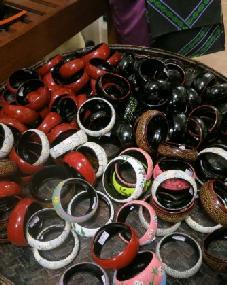
Bagan is also famous for its exquisitely decorated lacquerware, watch artisans create it in workshops in New Bagan. On November 12th we flew back to Yangon and spent the night in a hotel before everyone dispersed on the next day to their respective destinations.